If you’re an independent freight forwarder – moving ocean containers, air cargo, full truckloads, or anything else across a border – deciding which network to join isn’t a small decision. Membership fees aside, the wrong network can cost you months chasing partners who never deliver. Before signing with any global freight network, run it through this checklist.
What Is a Freight Network?
In logistics, a freight network refers to a formal membership group of independent freight forwarding companies that vet each other and agree to work together across borders – handling everything from ocean containers and air freight to full truckloads and vehicle shipments. Instead of forwarders vetting new partners shipment by shipment, the network does that vetting once, up front, for every member.
For the domestic equivalent of this idea, see our explainer on what auto transport is and how it works – a freight network is essentially that same matching function, scaled up to cover the whole world.
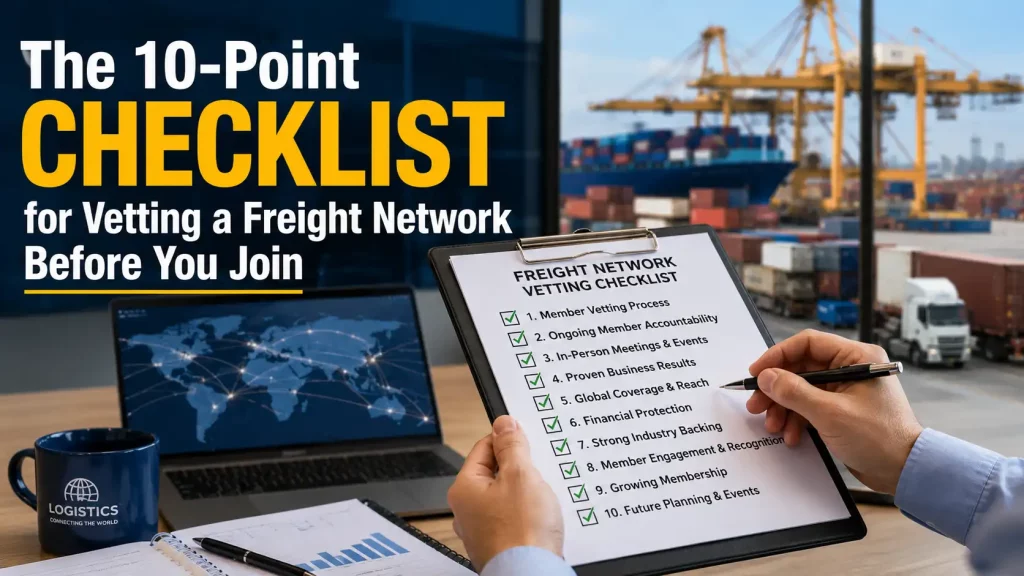
1. Does it vet members before granting access?
A directory that lets anyone in for a fee isn’t a network – it’s a mailing list. Ask whether prospective members go through an approval process, and whether the network keeps any public record (a blacklist, a compliance log) of companies that didn’t make the cut. IFN publishes both a vetted members directory and a public record of removed members.
Compare it to the licensing bar our own guide on how to become an auto transport broker describes – legitimate operators clear a real approval process too.
2. Does it keep vetting members after they join?
A one-time background check means little five years later. Look for a documented code of ethics and evidence that the network actually enforces it – not just a policy page nobody has ever invoked.
Our surety bonds guide for auto transport covers a similar ongoing-compliance requirement at the individual broker level.
3. Does it get members in a room together?
Digital directories are fine for discovery, but freight partnerships – regardless of mode – are still built face to face. IFN’s Global Connect 2026 conference at the Pullman Pattaya Hotel G in Thailand brought independent forwarders from 93+ countries together for four days of structured one-to-one meetings, not just a login page and a logo wall.
4. Can it point to real, attributable business results?
Ask what members actually walked away with. Mr. Ajaj Razak of FNI Logistics (Canada) said his company “received business inquiries before returning home” from IFN Global Connect 2026 – the kind of specific outcome a legitimate network should be able to produce on request.
It’s the same track record you’d want before trusting any of the best car shipping companies on our list.
5. Does its membership actually span the regions you need?
Geographic breadth only matters if it’s real. IFN’s 235+ vetted member companies span 154+ cities across 93+ countries – check any network’s numbers the same way before assuming coverage in the regions that matter to your business.
6. Does it protect you financially, not just introduce you?
Introductions are the easy part. The harder, more valuable feature is financial protection on cargo payments – a safeguard that matters if a partner on the other end of a deal doesn’t pay. Ask specifically what happens if a member transaction goes wrong.
This is the same question we tell readers to ask about their own auto transport insurance coverage before booking a shipment.
7. Will established companies publicly back it?
Check the sponsor list of its flagship event. IFN Global Connect 2026 drew sponsors including OTD Logistics (UAE/Philippines), Linking Line (Turkey/Saudi Arabia), Dispatch (USA/Egypt), Speedy Active Freight (Pakistan), and Senni Logistics (Mexico) – established freight and logistics companies willing to put their name on it.
See our Roadrunner Auto Transport review for an example of the kind of public track record worth checking before you trust a name.
8. Does it recognize members who actually show up and contribute?
Networks that only exist to collect dues rarely bother rewarding participation. IFN’s Founder Partnership Award, presented at the Global Connect gala night, recognizes member companies for active collaboration and leadership – a small but telling signal of an engaged community.
9. Is membership actually growing?
A stagnant member count is a warning sign. IFN reports 218+ active member inquiries logged this year on top of its existing 235+ member base – evidence of ongoing demand, not a network coasting on past growth.
10. Does it already have a future planned, not just one event?
One-off conferences suggest a one-off organization. Attendees at IFN Global Connect 2026, including Mr. Leo Kim of Global Logistics International, were already discussing “the 2027 event” before this year’s had even wrapped – a sign the calendar extends beyond a single marketing moment.
Run any prospective network through these ten questions before you commit a membership fee to it. IFN’s 2026 conference happens to check every box – vetted, accountable, in-person, financially protective, well-sponsored, and already planning ahead – regardless of whether the freight involved is a container ship or a car carrier.
See how IFN’s freight network holds up against this checklist.
Frequently Asked Questions
What is a freight network?
A freight network is a membership-based group of independent freight forwarders that vet each other and agree to a shared code of conduct, so members can hand off shipments to partners in other countries with a baseline level of trust already established.
How can I tell if a freight network is legitimate?
Check whether it actually vets members before admission, publishes a directory (and ideally a record of removed members), holds in-person events that produce real business, and has sponsors or member testimonials that are verifiable rather than generic.
What’s the difference between a freight network and an online freight marketplace?
A marketplace connects shippers and carriers on a transactional, often anonymous basis. A freight network connects vetted forwarding companies to each other for ongoing partnership – membership and accountability, not one-off bookings.
Is it worth paying to join a freight network?
That depends on whether the network delivers real vetting, real events, and real business outcomes, not just a listing. Membership fees (IFN’s start at $750/year) are usually far lower than the cost of building the same international partner relationships independently.
What should I check before joining a freight network?
Vetting standards, ongoing accountability (a code of ethics that’s actually enforced), the geographic spread of existing members, whether it offers financial protection on cargo payments, and whether its conferences produce documented business results for attendees.
Are freight network memberships only useful for large forwarders?
No – smaller, independent forwarders often benefit the most, since a network membership gives them the same international reach as a larger company’s owned office network, without the overhead.
For a real example of the marketplace model this question refers to, see our uShip auction review.